


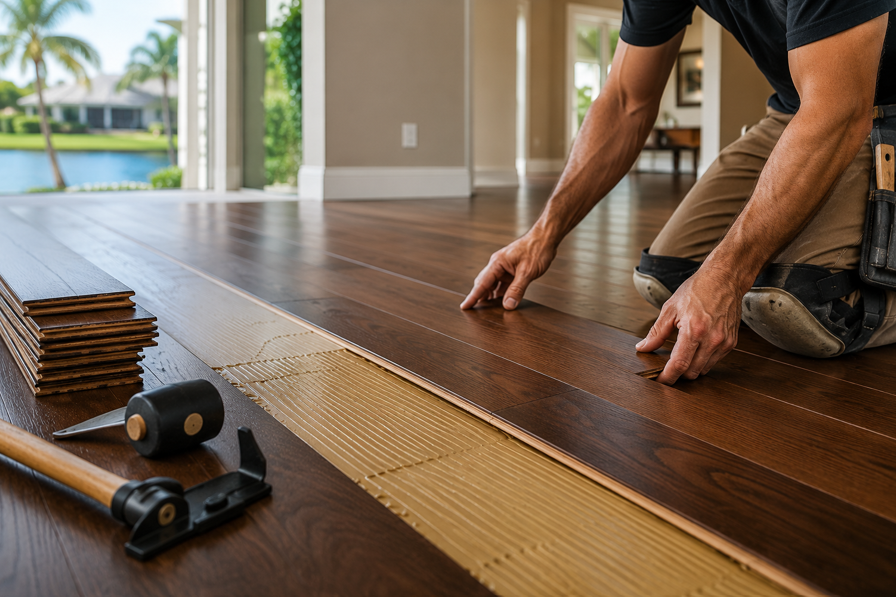
What Does NWFA Certification Actually Mean for a Homeowner?
Beautiful hardwood flooring is only part of a successful flooring project. How that wood is evaluated, prepared, installed, and finished can have a major influence on how the floor looks and performs once it becomes part of your home.
That is where installer qualifications matter.
The National Wood Flooring Association, or NWFA, offers professional certifications specifically for the wood flooring industry. Its Certified Professional program is designed to recognize and promote competence among wood flooring professionals through education, experience, and testing.
For a Bradenton homeowner, hiring an NWFA-certified installer means choosing someone who has gone beyond simply working with flooring products. Certified installers have completed industry-specific training and demonstrated knowledge related to installing real wood flooring.
That distinction matters in Florida, where wood flooring projects can involve concrete slabs, changing humidity, moisture testing, acclimation requirements, manufacturer specifications, and other conditions that need to be considered before the first plank is installed.
At LG Kramer Flooring, hardwood projects are supported by experienced installation professionals, including NWFA-certified installers who understand the technical details behind a quality finished floor.
Certification does not mean every flooring problem becomes impossible, nor does it guarantee that every project will be identical. What it does provide is an additional level of verified industry education and accountability when you are trusting someone with a significant investment in your home.
Why Hardwood Installation Requires Specialized Knowledge
Hardwood flooring can look simple when you see a finished room. Underneath that clean surface, however, there are many decisions that affect the installation.
Wood is a natural material. It responds to moisture and surrounding environmental conditions, which means an installer needs to consider more than plank width, color, and layout.
The Jobsite Needs to Be Evaluated
A hardwood installation begins before the flooring itself goes down.
The NWFA's current installation guidelines call for installers to assess and document jobsite conditions, including temperature, relative humidity, and subfloor moisture. For engineered wood flooring, the guidelines state that ambient conditions and subfloor moisture need to align with the requirements for the selected flooring.
That type of evaluation is particularly relevant in Bradenton.
Florida homes can have very different construction and site conditions. One property may have a concrete slab, another may involve a wood subfloor, and another may include existing flooring that needs to be removed before the underlying surface can be properly evaluated.
A qualified installer knows that the visible surface is only part of the project.
Moisture Cannot Be Treated as an Afterthought
Moisture is one of the most important considerations when working with real wood flooring.
The NWFA installation guidelines state that concrete subfloors need to be moisture tested before wood flooring installation and that appropriate moisture-control systems need to be in place when required. Unusually high or low readings also need to be identified and addressed rather than ignored.
This does not mean a Bradenton home automatically has a moisture problem simply because it is in Florida.
It means installers need to work with the actual conditions present in the home instead of assuming every property is ready for installation.
Manufacturer Requirements Matter
Different hardwood products can come with different installation instructions.
Manufacturers may specify:
Acceptable temperature ranges
Relative-humidity requirements
Subfloor preparation requirements
Approved adhesives
Fastener requirements
Moisture-testing procedures
Acclimation or conditioning instructions
Expansion-space requirements
Cleaning and maintenance procedures
NWFA guidance reinforces the importance of following the flooring manufacturer's moisture testing, acclimation, installation, and maintenance instructions, including where warranty coverage is concerned.
That is one reason specialized wood-flooring knowledge adds value.
What Does an NWFA-Certified Installer Have to Do to Earn Certification?
NWFA certification is not simply a membership badge.
The Certified Installer designation has defined professional requirements designed to demonstrate experience and industry knowledge.
Relevant Work Experience Is Required
According to the NWFA's certification requirements, Certified Installer candidates need either three years of on-the-job installation experience, one year of installation experience combined with qualifying education, or completion of an approved Wood Floor Specialist apprenticeship pathway.
That experience requirement helps distinguish professional certification from a short introductory course.
Wood installation skills develop through a combination of technical education and real-world work. Installers encounter different species, products, subfloors, room configurations, jobsite conditions, and installation methods throughout their careers.
Intermediate Installation Education Is Part of the Process
Certified Installer candidates are also required to attend the NWFA Intermediate Installation course.
NWFA's educational programs are built specifically around the wood flooring trade. Its training resources cover subjects ranging from installation and moisture to subfloors, jobsite evaluation, sanding, finishing, and problem prevention.
That flooring-specific focus is important.
General construction experience is valuable, but hardwood has its own set of material behaviors, manufacturer requirements, installation methods, and industry practices.
Candidates Complete Technical Coursework or Testing
NWFA certification requirements also include completion of installation coursework through NWFA University or an approved written examination pathway.
NWFA University is an online education platform developed specifically for wood flooring professionals and offers hundreds of courses covering technical and professional subjects.
The result is a certification designed around actual wood-flooring knowledge rather than a general claim of experience.
Certified Professionals Agree to a Code of Conduct
Certified Installer candidates are also required to sign the NWFA Certified Installer Code of Conduct.
For homeowners, that adds another meaningful layer to the credential. Certification represents not only training but participation in an established professional program with defined standards.
How Can NWFA Certification Help Protect Your Flooring Investment?
Hardwood flooring can be a substantial investment in a home. Choosing qualified people to install it helps protect that investment from preventable installation problems.
Better Attention to Site Conditions
One of the biggest advantages of technical flooring education is understanding what needs to be checked before installation.
A knowledgeable wood-flooring installer recognizes that problems may start with conditions that are not obvious when you first walk into a room.
Potential considerations can include:
Excess moisture in a concrete slab
Unexpected wood-subfloor moisture
Uneven or unsuitable substrates
Interior conditions outside product requirements
Inappropriate flooring storage
Existing flooring or adhesive that affects preparation
Transition-height concerns
Manufacturer-specific installation restrictions
The NWFA provides industry-accepted technical guidelines, jobsite checklists, moisture resources, and other technical publications to help flooring professionals address these kinds of conditions.
Proper Conditioning and Acclimation Decisions
Homeowners often hear that hardwood needs to "sit in the house for a few days" before installation.
In reality, proper conditioning is more specific than following a universal number of days.
NWFA guidance explains that installation readiness depends on factors including the flooring, subfloor, expected in-use conditions, manufacturer requirements, temperature, humidity, and moisture content. Some products may be ready for installation when those conditions align, while other situations may require additional conditioning.
A trained installer evaluates those factors rather than relying on a one-size-fits-all rule.
The Correct Installation Method
Not every wood floor is installed the same way.
Depending on the flooring and site, installation may involve:
Nail-down methods
Staple-down methods
Glue-down installation
Floating systems
Patterned installations
Installation over concrete
Installation over wood subfloors
The right method depends on the flooring manufacturer's instructions, product construction, substrate, and project conditions.
Homeowners browsing hardwood flooring may notice significant differences between products that initially appear similar. Working with experienced professionals helps connect the product selection to an appropriate installation method rather than treating the two decisions separately.
Details at Walls, Doorways, and Transitions
Quality installation also shows up in the details.
An installer needs to consider expansion space, transitions to other flooring surfaces, door clearances, baseboards or trim, cabinets, stairs, vents, room direction, and layout.
A beautiful hardwood product can lose much of its visual impact if those finishing details look rushed.
The goal is not simply to cover the subfloor. It is to create a finished flooring system that looks intentional throughout the space.
Why Bradenton's Climate Makes Installation Experience Important
Florida's climate makes technical flooring knowledge especially useful because wood naturally responds to its surrounding environment.
Wood and Moisture Are Connected
Wood contains moisture, and its moisture content can change as surrounding conditions change.
That natural movement is one reason the NWFA publishes dedicated technical information about moisture and regional climate variations. Its installation guidelines emphasize matching wood flooring and subfloor conditions with the expected environment of the building.
The takeaway for Bradenton homeowners is straightforward: moisture conditions deserve to be measured, not guessed.
Air Conditioning Is Part of the Indoor Environment
Most Bradenton homeowners rely heavily on air conditioning for much of the year.
That makes the home's normal occupied conditions relevant to the flooring project. If flooring is delivered or installed while a building is operating under conditions that are very different from how it will normally be lived in, those differences can matter.
NWFA guidance calls for temperature and relative humidity to meet the flooring manufacturer's requirements before and during installation.
A qualified installer understands how to evaluate the indoor environment alongside the flooring product.
Storms and Water Intrusion Are Different From Normal Humidity
Florida humidity and actual water intrusion are not the same issue.
A plumbing leak, roof problem, storm-related water event, or moisture concern beneath a slab may require attention before hardwood installation moves forward.
Professional evaluation is valuable because installing over a known moisture problem can put the new flooring investment at risk.
The right approach is to identify and address the underlying condition first.
Is an NWFA-Certified Installer Better Than Any Installer Who Is Not Certified?
Certification is an important qualification, but homeowners can still look at the complete professional picture.
A highly experienced installer without a particular certification may have substantial practical knowledge. Likewise, certification alone does not eliminate the need to evaluate the company performing the work.
The strongest hiring decision considers several factors together:
Relevant hardwood installation experience
NWFA certification or other professional education
Knowledge of manufacturer requirements
Local project experience
Clear project communication
Appropriate jobsite preparation
Reputation and customer feedback
Attention to detail
Professional installation practices
Ability to explain concerns before work begins
NWFA itself describes its Certified Professional program as a way of validating industry knowledge and expertise through specific online and hands-on testing.
Think of certification as a meaningful trust signal, not the only question worth asking.
Do Hardwood Manufacturers Care About NWFA Certification?
Yes, many wood-flooring manufacturers recognize the value of NWFA-certified professionals.
The NWFA maintains a list of member manufacturers that recommend using an NWFA Certified Professional with their flooring products. According to the organization, certified professionals participate in training intended to improve flooring performance and service to consumers.
That manufacturer support reinforces an important point: professional installation is closely connected to product performance.
A premium hardwood plank still depends on:
Proper storage
Suitable jobsite conditions
Correct preparation
Appropriate moisture testing
Approved installation materials
Correct installation techniques
Manufacturer instructions
Choosing quality flooring and quality installation together gives the project the strongest foundation.
Certification Also Encourages Continued Learning
Flooring products, adhesives, equipment, installation methods, finishes, and technical guidance continue to evolve.
A professional who learned the trade years ago still benefits from staying connected to current industry practices.
The NWFA provides ongoing education through online courses, webinars, workshops, technical publications, hands-on training, and industry events. Certification also comes with continuing-education and annual maintenance requirements designed to keep certified professionals engaged with industry knowledge.
That ongoing-learning component is useful for homeowners because today's flooring projects may include products and installation systems that were less common in previous decades.
Experienced craftsmanship and continued technical education work well together.
Questions to Ask Before Hiring a Hardwood Installer
Even when an installer is certified, homeowners can ask a few practical questions before choosing a flooring company.
Are You NWFA Certified?
Ask what certification the installer holds rather than relying on a general statement that a company is "trained."
The NWFA offers several different professional certifications, including Certified Installer, Certified Sand & Finisher, Certified Sales Advisor, Certified Wood Flooring Inspector, Certified Craftsman, and Certified Master Craftsman.
The certification relevant to your project depends on the work being performed.
How Will You Evaluate My Subfloor?
The installer needs to understand what the hardwood is being installed over.
Ask whether the project involves concrete, plywood, an existing flooring surface, or another substrate, and what preparation may be necessary.
Will Moisture Conditions Be Checked?
For hardwood projects, this is a valuable question.
Ask how the installer evaluates jobsite and subfloor moisture and how those results are compared with manufacturer requirements.
Which Installation Method Is Right for This Floor?
A professional can explain why a particular product will be nailed, glued, stapled, floated, or installed using another approved approach.
You do not need to become a flooring technician yourself. The goal is to hear a clear explanation based on the product and property.
What Happens If the Jobsite Is Not Ready?
This question can reveal a lot.
A quality professional is prepared to explain what needs to be corrected if moisture, substrate conditions, or another issue makes immediate installation inappropriate.
Delaying installation until an underlying issue is addressed can be far better than moving forward simply to stay on schedule.
How Do You Handle the Details?
Ask about transitions, stairs, trim, furniture, flooring removal, disposal, and any other parts of the project that matter to your home.
Knowing what is included helps create clearer expectations from the beginning.
Why Local Experience Still Matters Alongside Certification
Certification verifies industry knowledge, while local experience adds an understanding of the homes and projects encountered in the Bradenton area.
LG Kramer Flooring has worked in the flooring industry since 2009 and completes projects across Bradenton, Lakewood Ranch, Sarasota, Longboat Key, Parrish, and surrounding communities.
That local experience can be useful when working with Florida construction, concrete subfloors, occupied homes, remodels, new flooring selections, and projects where existing materials need to blend with new finishes.
The company has also invested in NWFA certification for members of its team, combining professional education with hands-on installation experience.
For homeowners, that combination matters because hardwood installation is both technical and visual.
The installer needs to understand moisture, substrates, products, and manufacturer instructions, but also needs the craftsmanship to create clean lines, attractive layouts, thoughtful transitions, and a polished finished result.
Make Installation Quality Part of Your Hardwood Decision
It is easy to spend most of the flooring-selection process comparing species, plank widths, colors, textures, and finishes.
Those choices matter, but the people installing the floor deserve just as much attention.
An NWFA-certified hardwood installer brings verified wood-flooring education to the project. Certification requirements include professional experience, specialized installation education, technical coursework or examination, and participation in the NWFA Certified Professional program.
For a Bradenton homeowner, that knowledge can be particularly valuable when a project requires careful attention to:
Moisture conditions
Concrete or wood subfloors
Product conditioning
Manufacturer specifications
Installation methods
Layout
Expansion requirements
Transitions and finishing details
No certification can promise that a floor will never encounter damage or changing conditions over its lifetime. It can, however, give homeowners another strong reason to feel confident that their installer has invested in understanding the craft.
LG Kramer Flooring combines product guidance, local flooring experience, and skilled installation to help homeowners make informed decisions from selection through completion.
If you are planning new hardwood floors in Bradenton and want to work with professionals who understand both the beauty and technical demands of real wood, get in touch with the LG Kramer Flooring team to discuss your project.


